.png)
.png)
.png)
This guide covers residential and light commercial epoxy projects in the Worcester area. It does NOT address industrial warehouse coatings over 5,000 sq ft, which follow different pricing models entirely.
Epoxy flooring cost in Worcester refers to the total expense of applying a resin-based protective coating toconcrete surfaces — including materials, labor, and surface prep. In Worcester,MA, most homeowners pay between $4 and $12 per square foot for professional installation, with the average garage project landing between $2,800 and $5,500.
That range is wide. Here's why it matters, and how to figure out which end you're on.
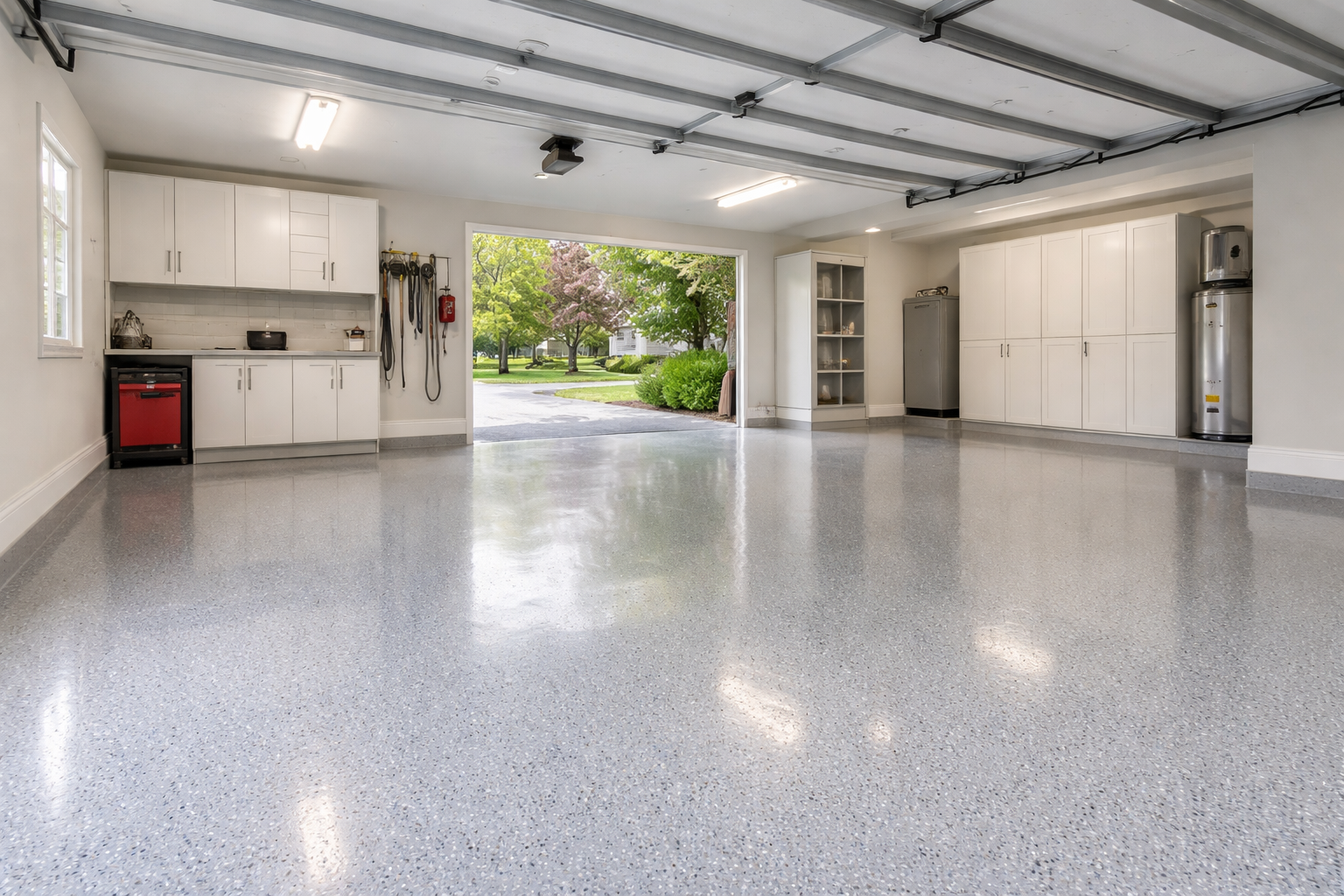
According to HomeGuide (2026), professional epoxy flooring installation averages $4–$10 per square foot nationally. Worcester-area projects tend to run 15–25% higher than that national midpoint — Massachusetts labor rates and material logistics push cost sup compared to Sun Belt markets where most of those national averages are calculated.
For context, here's what real project rangeslook like locally:
These aren't guarantees. They're the ranges Worcester homeowners encounter when they get 2–3 competitive quotes.
Quick note: the $3–$7/sq ft figures you'll see on national sites like Angi are real, for markets like Phoenix or Charlotte. Worcester isn't Phoenix.
What most guides skip is that surface prep is often the single biggest variable in a Worcester epoxy quote. And it's theone line item contractors are most likely to underspecify in a low-ball bid.
Concrete must be ground, cleaned, and fully dry before epoxy adheres properly. In New England, freeze-thaw cycles cause micro-cracking and moisture migration in concrete slabs that most warmer-climate guides never mention. If a Worcester contractor pulls a moisture test and your slab is reading above acceptable levels, common in older homes built before modern vapor barriers. You're looking at an additional $200–$600 in prep work before a single coat of resin touches the floor.
Crack repair adds $25–$250 depending on severity. Grinding an old painted or sealed surface adds $1–$2/sq ft.
Don't let a quote skip this. Ask directly: "What does your surface prep include, and what could change that price?"
A Rust-Oleum EpoxyShield DIY kit runs $100–$300 and covers a 1-car garage. It's water-based, which means it'll look great for a few years — then peel. Most Worcester contractors use Sherwin-Williams ArmorSeal or equivalent 100% solid systems for professional installs. Some are shifting toward Penntek polyaspartic coatings, which cure in 24 hours instead of 72 — a real advantage when a homeowner can't have their garage out of commission for three days in November.
Or maybe I should say it this way: the difference between a $4/sq ft quote and a $10/sq ft quote is almost always the product spec and prep depth, not contractor profit margin.
Plain gray epoxy is the cheapest option.Color flakes (broadcast flakes) add texture and hide dirt — they run $1–$2/sqft extra and are worth it for garages. Metallic epoxy finishes with swirl effects cost $3–$5/sq ft more and are primarily aesthetic.
Anti-slip additives are not optional for Worcester basements or garage ramps. They typically add $0.50–$1/sq ft and area liability question, not just a style preference.
I've seen conflicting data on this — some national sources cite $50–$100/hr for epoxy labor, while Worcester-area contractor pricing implies effective rates of $75–$130/hr when you back-calculate from installed quotes. My read is that the national figures reflect regional averaging across lower-cost states. Expect Worcester labor to land in the $85–$120/hr range for experienced crews.
Most jobs send two workers. A standard 2-cargarage takes 1–2 prep days plus 1 application day, plus cure time. That's real crew cost.
Look, if you're coating a small basement utility room and aren't precious about it lasting a decade, a DIY kit isn't crazy. Here's what that looks like honestly:

1. Clear and degrease the concrete surface completely
2. Etch with muriatic acid ormechanical grind (do not skip this)
3. Check moisture — use plastic sheet test for 24 hours
4. Mix and apply base coat permanufacturer instructions
5. Broadcast flakes if desired, allow cure time per spec
6. Apply top coat sealer; keep off floor for 72 hours minimum
The risk isn't effort — it's moisture. Worcester's older housing stock has slab moisture issues that cause DIY epoxy to delaminate within 18 months. That's the failure mode contractors see mostoften when a homeowner calls for a redo.
Some experts argue DIY is fine for light residential use. That's valid for newer construction with modern vapor barriers. But if you're in a pre-1980 Worcester triple-decker or cape, get themoisture tested first — before you spend $300 on a kit that won't stick.
Professional installations typically come with 5–10 year warranties. DIY kits come with a return window.
This is where homeowners get burned. A quote that just says "$3,200 for garage floor" tells you almost nothing.
A real quote from a Worcester contractor should break out:
· Square footage being coated (measure it yourself — verify)
· Surface prep method (grinding vs. acid etch) and any moisture mitigation
· Epoxy product name, brand, and number of coats
· Whether top coat/sealer isincluded or separate
· Timeline: prep day(s), application day, earliest use
· Warranty terms in writing
If a contractor won't give you this breakdown, they're protecting their ability to add charges mid-job.

Most Worcester homeowners pay $2,800–$5,500 for a 2-car garage. Per square foot, expect $5–$12 depending on prep needs, epoxy type, and finish options. National averages run lower.
100% solid epoxy or polyaspartic coating. Both handle New England freeze-thaw stress better than water-based systems, which tend to peel within a few years on older slabs.
Professionally installed 100% solid epoxy lasts 10–20 years with basic maintenance. Water-based systems last 3–5 years. Climate and slab condition are the biggest variables locally.
Only if the slab is newer construction with no moisture issues. Worcester's older housing stock has high DIY failure rates due to slab moisture — get a moisture test before buying a kit.
Always — and get at least three. Prices for the same job vary by $1,000–$2,500 depending on product spec and prep depth. Compare line items, not just totals.


.png)
.png)